
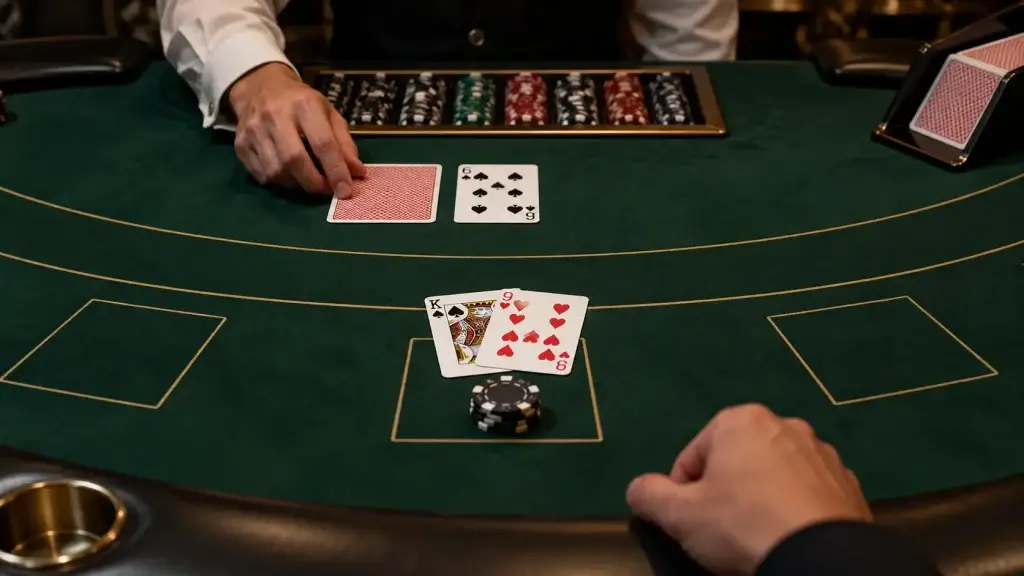
Blackjack is a card game in which the player tries to finish with a stronger qualifying hand than the dealer without allowing the total to exceed 21.
That objective is easy to understand, but the game becomes more interesting once the table rules are taken into account. Blackjack payouts, deck count, dealer behaviour, doubling conditions and splitting rules can all vary, meaning two tables with the same game name are not necessarily identical.
A round begins with cards being dealt to the player and dealer. The exact presentation depends on the version being played, but the player normally receives enough information to decide how to continue the hand.
Typical actions include hitting for another card, standing on the current total, doubling under defined conditions or splitting an eligible pair into two separate hands.
When the player’s decisions are finished, the dealer completes the dealer hand according to fixed rules. The dealer does not normally choose a strategy in the same way as the player; the table determines when another card must be drawn and when the dealer must stop.
Number cards from 2 to 10 are worth their displayed value, while kings, queens and jacks are worth 10.
The ace is different because it can normally count as either 1 or 11, depending on which value produces the stronger legal hand.
An ace with a 7 can therefore be worth 18 with the ace counted as 11. If a later card would push the total above 21, the ace may instead count as 1 where that keeps the hand alive.
This flexible value creates the distinction between hard and soft hands.
A soft hand contains an ace that can currently count as 11 without taking the total above 21. Ace-6, for example, is commonly described as soft 17.
A hard 17 such as 10-7 does not have the same flexibility. Drawing a sufficiently high card will take the total above 21 because there is no ace available to fall from 11 to 1.
The same displayed total can therefore represent a different situation depending on how the hand was formed.
A natural blackjack is normally an ace combined with a 10-value card in the first two cards of the hand.
That produces 21 immediately.
It is important to distinguish a natural blackjack from a hand that reaches 21 using three or more cards because the two outcomes may not be settled in the same way.
The payout for a natural blackjack is particularly important. A table paying 3:2 does not return the same amount as one paying 6:5 for the same hand.
For that reason, the natural-blackjack payout is one of the first table rules worth checking.
Blackjack differs from many casino games because decisions can continue after the first cards have been dealt.
To hit is to request another card.
To stand is to keep the current total and take no additional cards.
If another card pushes the hand above 21, the player busts and loses that hand without needing to compare the total with the dealer.
The decision therefore depends on both the player’s hand and the information visible about the dealer.
Doubling normally allows the player to increase the stake in exchange for receiving one additional card, after which the hand stands.
The exact rules vary. Some tables allow doubling on a wide range of initial two-card totals, while others restrict it to particular values.
Another difference is whether doubling after a split is permitted.
Those conditions affect the decisions available during play, so they form part of the core rules rather than being a minor extra feature.
When the first two cards form an eligible pair, the table may allow them to be separated into two hands.
An additional stake is normally required for the new hand, and each hand is then played independently.
Tables can differ in the number of times a player may split, how 10-value cards are treated and what happens when aces are split. A 21 produced after splitting may also be settled differently from a natural blackjack dealt in the original two cards.
The dealer normally follows instructions built into the table rules.
A common structure requires the dealer to draw on totals below 17 and stop on 17 or more. The treatment of soft 17 is one of the important variations.
Some blackjack tables require the dealer to stand on soft 17. Others require another card to be drawn.
That difference may look small during one hand, but it affects the mathematical conditions of the game over a large number of rounds.
The rule is therefore worth identifying before choosing a table.
Blackjack can be played with one deck or with several decks combined into a shoe.
Many online and live games use multiple decks.
Deck count interacts with the other table rules and changes the composition of the cards available as play progresses. It does not mean that a particular number of decks guarantees a favourable outcome.
The practical point is simpler: a single-deck blackjack game and an eight-deck game should not automatically be treated as mathematically identical just because the objective is the same.
The game name tells you only part of what you need to know.
Useful rules to compare include the payout for a natural blackjack, the number of decks, whether the dealer hits or stands on soft 17, when doubling is allowed and how split aces are handled.
Some games also offer surrender or additional side bets. These should be assessed separately because they introduce their own conditions and probability structures.
The visual theme of the table tells you much less about the game than these rules do.
When the dealer shows an ace, some tables offer an insurance wager.
Insurance is a separate bet on whether the dealer’s hidden card will complete a natural blackjack. It should not be interpreted as general protection for the player’s original hand.
The wager has its own stake and payout and is settled according to whether the dealer actually has blackjack.
Other side bets can also appear around the main game, including wagers based on pairs or specific card combinations. Their rules and probabilities are separate from the standard blackjack hand.
Blackjack decisions can be analysed mathematically because the player can see part of the information before choosing an action.
This is why basic strategy charts exist. They compare the player’s hand with the dealer’s visible card under a defined set of rules and identify the mathematically preferred action for that situation.
They do not predict which card will appear next.
That distinction matters. Strategy can improve the quality of a decision under known conditions, but it cannot turn an uncertain card sequence into a guaranteed result.
A strategy chart should also match the rules being played. Changes to deck count, soft-17 rules, doubling or surrender can alter the appropriate decision in some situations.
Digital blackjack resolves each hand through software and can generally move quickly because there is no need to wait for a live dealer or other participants.
Live blackjack connects the player to a dealer handling the cards through a video stream. Decisions are selected through the interface, usually within a timed window because multiple players can be following the same round.
The format changes the pace and presentation, but it does not replace the table rules. A live game can still use different payouts, deck counts and dealer conditions from another blackjack table.
Cryptocurrency changes how funds can move into or out of an account; it does not change the value of the cards.
Once a blackjack round begins, the hand follows the rules of the selected table regardless of whether the account was funded using cryptocurrency or another supported payment method.
The broader crypto casino information on Spino Dubai therefore addresses a different part of the experience: assets, blockchain networks, wallet addresses and transaction processing.
Blackjack should still be evaluated through its own rules, payouts and available decisions.
Blackjack and roulette are both traditional table games, but they place the player’s decisions in very different places.
Blackjack allows the player to respond after the initial cards are visible. Hitting, standing, doubling and splitting can all happen during the hand.
With online roulette, the wager is normally selected before the wheel produces the result. Once betting closes, there is no comparable sequence of decisions during the spin.
Neither structure makes an outcome certain. The distinction is simply that blackjack offers decisions based on information revealed during the hand, while roulette concentrates the main choices before the result is generated.
The most useful comparison begins with the rules rather than the design of the table.
Check the natural-blackjack payout, the number of decks and whether the dealer hits or stands on soft 17. Then review the doubling rules, whether doubling after a split is permitted and how split aces are treated.
If the table includes surrender, insurance or side bets, read those conditions separately rather than assuming they are part of standard blackjack.
Once those details are clear, the objective remains simple: keep the hand at 21 or below, finish with a stronger qualifying total than the dealer and make each decision according to the rules of the table being played.