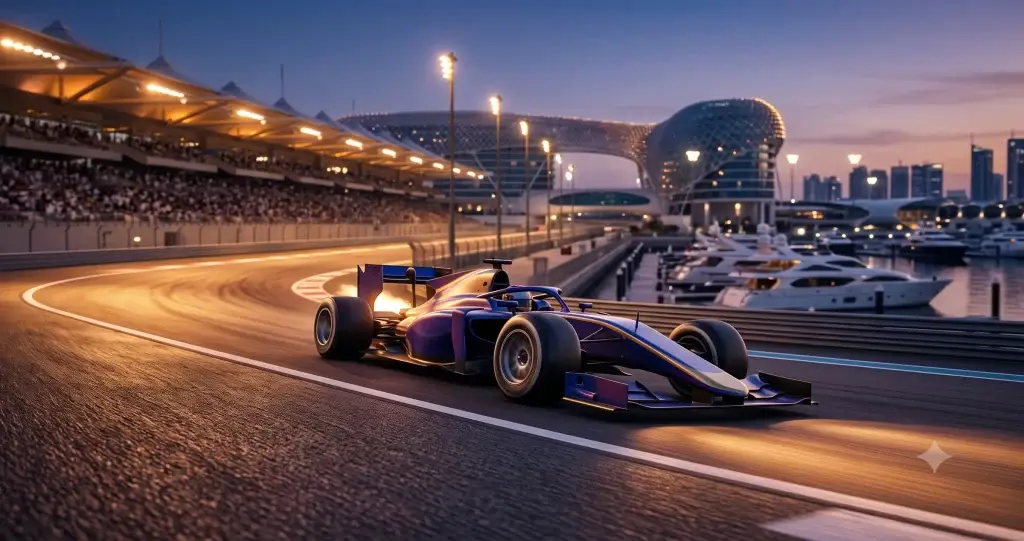
The Abu Dhabi Grand Prix returns to Yas Marina Circuit from 4 to 6 December 2026 as the final round of the Formula 1 season.
Since joining the championship in 2009, Abu Dhabi has developed a distinctive role on the calendar. The race starts in the late afternoon and finishes under the floodlights, while its position at the end of the season means the weekend can carry implications for championships, final standings and the last major decisions of the year.
The 2026 edition is particularly notable because it closes the first season under Formula 1’s new generation of technical regulations.
When is the 2026 Abu Dhabi Grand Prix?
The 2026 Abu Dhabi Grand Prix weekend is scheduled for 4–6 December.
Friday features the opening practice sessions, Saturday contains final practice and qualifying, and the Grand Prix takes place on Sunday.
As always with Formula 1, the official event schedule is the best reference close to race weekend because session times or supporting programmes can be updated.
Abu Dhabi follows Qatar on the 2026 calendar, making Yas Marina the final stop of the championship.
What is Yas Marina Circuit like?
Yas Marina Circuit is located on Yas Island in Abu Dhabi and hosted its first Formula 1 Grand Prix in 2009.
The current circuit measures 5.281 kilometres. A full Grand Prix runs for 58 laps, producing a race distance of just over 306 kilometres.
The layout combines several different demands rather than relying on one dominant type of corner.
There are fast sections where aerodynamic confidence matters, a long straight that creates a major overtaking opportunity, and a slower final part of the lap where drivers must place the car accurately close to the barriers and circuit infrastructure.
This mixture forces teams to balance straight-line speed with grip and stability through the slower corners.
Why is the long straight so important?
One of the defining parts of Yas Marina is the roughly 1.2-kilometre straight between Turns 5 and 6.
Cars accelerate hard before entering a heavy braking zone, creating an obvious opportunity for drivers to challenge one another.
The approach is especially important because a driver who gets a strong exit from the preceding corner can carry additional speed onto the straight.
In 2026, this section has gained another technical dimension because the new Formula 1 cars use a different combination of active aerodynamics and electrical energy deployment from the previous generation.
How did the 2026 Formula 1 rules change the cars?
Formula 1 entered a new technical cycle in 2026, with significant changes to both the chassis and power unit.
The cars are smaller and lighter than the previous generation. The maximum wheelbase has been reduced, overall width has decreased, and the regulations were designed around a more agile concept.
The power units also place much greater emphasis on electrical energy. The MGU-H has been removed, while the MGU-K can deliver substantially more electrical power than under the previous regulations.
The combustion engine remains a 1.6-litre turbocharged V6, but the balance between combustion and electrical power is much closer than before.
The cars also run on advanced sustainable fuel as part of Formula 1’s new power-unit framework.
What replaced DRS in 2026?
The traditional DRS system is no longer the main overtaking mechanism used by the 2026 cars.
Instead, the regulations combine active aerodynamics with an electrical overtaking aid.
Active front and rear aerodynamic elements allow the car to reduce drag on suitable parts of the circuit while maintaining the necessary aerodynamic configuration for corners.
For overtaking, drivers can gain access to additional electrical deployment when the relevant conditions are met behind another car.
The system serves a different purpose from the old DRS flap. Active aerodynamics primarily help the cars manage drag and energy, while the additional electrical deployment is designed to assist overtaking.
Yas Marina’s long straights make this one of the circuits where those differences should be particularly visible.
Why does Abu Dhabi regularly close the Formula 1 season?
Abu Dhabi has become closely associated with Formula 1’s final round.
The event offers several practical advantages for a season finale: a modern permanent circuit, extensive paddock and hospitality infrastructure, predictable evening conditions and a race format that transitions from daylight into darkness.
But its position also gives the weekend sporting importance.
If either championship remains undecided, Yas Marina becomes the final opportunity to change the outcome. Even when the titles are settled earlier, teams and drivers can still be competing over championship positions that affect how the season is ultimately recorded.
Important moments in Abu Dhabi Grand Prix history
Yas Marina has already hosted several significant championship moments.
Sebastian Vettel secured his first Formula 1 world title at the circuit in 2010 after arriving at the final race behind other championship contenders.
The 2021 event became one of the most discussed season finales in modern Formula 1 history when Max Verstappen won the drivers’ championship on the final lap.
The circuit has also decided constructors’ championships, including McLaren’s 2024 title.
These moments explain why Abu Dhabi’s role as the final race has become part of the event’s identity rather than simply a position on the calendar.
Why the race begins in daylight and finishes at night
One of the most recognisable features of the Abu Dhabi Grand Prix is its twilight format.
The race begins while there is still natural light over Yas Island, then continues as the sun sets and the circuit’s floodlights take over.
This produces a visual transition that few other Formula 1 events reproduce in the same way.
The changing conditions can also matter technically. Track and air temperatures can fall through the race, influencing tyre behaviour and the way teams manage their cars over a stint.
What should viewers watch during the race?
Yas Marina rewards more than outright top speed.
The long straights make straight-line performance important, but the final sector places a premium on traction, precision and confidence through slower corners.
Qualifying can matter because track position reduces the amount of traffic a driver needs to manage, but the long braking zones still create opportunities for movement during the race.
Strategy is another important element. Tyre performance, pit-stop timing and the timing of safety-car periods can all reshape a race even when the starting order looks predictable.
The 2026 regulations add another variable because teams are still learning how to optimise a fundamentally new generation of cars.
Abu Dhabi within the UAE sporting calendar
The Grand Prix is one of the UAE’s major international sporting events and brings Formula 1 to the country at the end of each season.
It also sits within a broader calendar that includes international football, golf, cricket and major tennis events.
For fans following sport in the Emirates throughout the year, events such as the Dubai Tennis Championships create a different type of international competition while reinforcing the UAE’s role as a recurring host for global sport.
What makes the 2026 Abu Dhabi Grand Prix different?
The fundamentals of Yas Marina remain familiar: 58 laps, a twilight start, long straights and the final race of the year.
What changes in 2026 is the machinery.
The new power units, greater electrical contribution, active aerodynamics and revised overtaking systems mean teams arrive in Abu Dhabi with a different set of technical priorities from the previous generation.
That makes the season finale an important benchmark. By December, teams will have accumulated almost a full season of experience with the new rules, and Yas Marina will show how far they have progressed since the opening rounds.